More Providers Where the Need is Greatest
Federal Grant Adds PA Students to Rural Healthcare
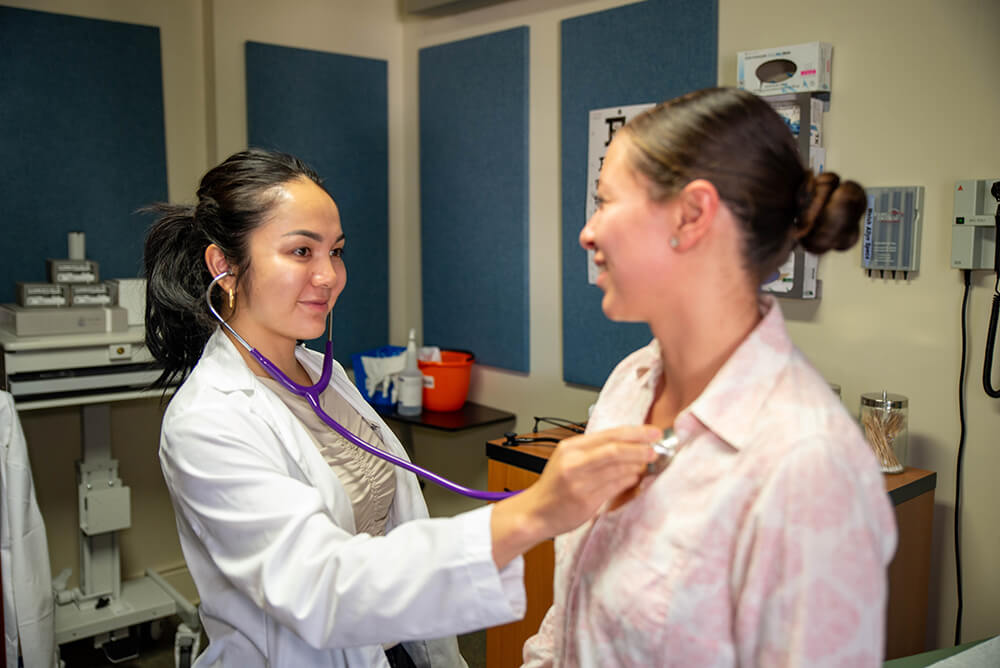
As the only physician assistant (PA) training program in the country where all students get both Master of Science in Physician Assistant Studies (MSPAS) and Master of Public Health (MPH) degrees, Touro University California’s Dual MSPAS/MPH Program was built on a mission: assist underserved communities by increasing access to high-quality, culturally sensitive healthcare.
The program recruits students aligned with that mission, who want to add the wider public health lens to their practice.
Now that mission has gotten a big boost: A five-year REACH (Rural Education and Community Health) grant from the U.S. Health Resources and Services Administration (HRSA) has increased the number of Touro PA students training in some of northern California’s most rural counties.
These are communities, and clinic sites, in some of the most challenging situations in American healthcare – understaffed, underfunded and seeing patients whose health has often been deeply compromised by poverty.
Adding Public Health to PA Practice
Touro’s Dual Program is proud to be one of only 12 PA programs nationwide, and the only program in California, to receive the REACH grant. The grant embodies what Touro students will add to healthcare across the U.S. – not just in practice, but also in policy and administration.
“I’m a Dual PA/MPH grad, and I think having the MPH gave me the skill set to write these grants. Not only can I see patients, but I’m also able to think of a bigger picture of how I can effect change,” says Program Director Joy Moverley, DHSC, MPH, PA-C and Class of 2012.
Increasing Rural Provider Capacity
One of the REACH grant sites is the Round Valley Indian Health Center, which serves the approximately 3,000 people living on the Round Valley Indian Reservation and in the tiny northern California mountain town of Covelo. Touro PA students have done six-week training rotations at Round Valley since 2022. The grant doubles those numbers to 12-week placements and two students at a time.
“Sometimes we’re down to one provider, and that’s pretty hard,” says Rose Abono, clinic manager for the medical facility at Round Valley. “That’s when you really appreciate your PA students.”
Complex Needs, Limited Resources
Training in a facility without enough providers means that Touro’s PA students are immediately thrown into the deep end.
“While it was a primary care clinic, it also felt more like an urgent care,” says Neil Daag, a Touro alum with the MSPAS/MPH Class of 2025 who rotated through Round Valley in August and September 2024. “Some people have really complex conditions. Sending out to specialty care was a challenge, just because it takes so much time to get out of the valley.”
Providing Care in Challenging Locations
Round Valley struggles because of its remote location: It is over an hour from the nearest hospital, often snowed-in in winter, when mountain roads become unpassable, and endures power and internet outages – which take down the Electronic Health Record – year round.
“I tell students to be prepared to live sometimes like you’re camping,” says Abono. “I think it’s a great eye-opener to see what it’s really like to be so far away from help, and from things that everybody takes for granted.”
Yet the clinic turns no one away. Abono set up an outdoor care bay during the COVID-19 pandemic. They transport patients three days a week to a dialysis facility an hour and a half away. Touro students accompany providers on house calls. And the patient population includes seasonal farmworkers, who often need connections to food assistance and insurance.
Daag says those challenges helped strengthen his practice.
“They need the help, and there’s just not enough providers,” he says. “They appreciate and expect the students to step in and be ready. That helped me, or forced me, to learn and grow my confidence a lot quicker than I thought I would. I felt a lot more autonomy and feeling like a provider in this setting than I have in my other rotations.”