
Bright Shirts, Big Impact in Vallejo
Orientation Sends Future Leaders into the Community
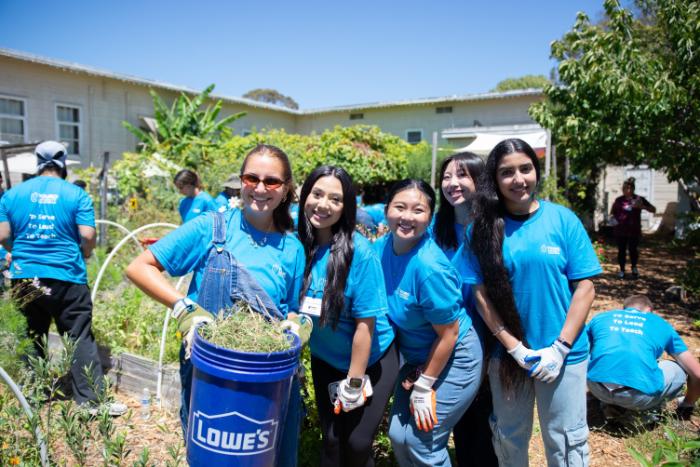
Bright, colorful t-shirts dot community sites across Solano County every summer as a new cohort of Public Health, Nursing, Diagnostic Medical Sonography, Pharmacy, Osteopathic, Radiologic Technology, and Medical Health Sciences students take their first steps together on the Touro University California (TUC) campus.
Before these future health professionals sit down in a classroom, they gather in the Lander Hall gym and auditorium, meeting their peers and kicking off their journeys here at TUC. After introductions to campus leadership and a complete tour of the university, the energy builds quickly as the entire incoming class divides into smaller teams, boarding buses bound for community and non-profit sites around Vallejo and Benicia. They head off to tackle projects that most locals will never see, but the ripple effects are felt deeply across the region.
Throughout the morning, students log roughly 900 hours of direct community service, transforming an ordinary orientation day into a massive show of support for local non-profits.
Day of Service
This year, the university expanded its reach by introducing a brand-new service partnership with the Benicia Community Foundation. Small student groups fanned out through neighborhoods around Channing Circle Park, working on community safety initiatives and connecting directly with local residents. By plunging headfirst into local neighborhoods from day one, these incoming students demonstrate that healing and care extend far beyond traditional hospital walls.
Telorah Kawakami, an incoming student in the Diagnostic Medical Sonography program noted, "Today was really fun. I enjoyed walking around Benicia and just being able to help the community."
Across town at the Vallejo People's Garden, 80 TUC students spent their time clearing away overgrown brush and turning over nutrient-rich soil. Their hard work prepares the garden beds for new seasonal crops, directly supporting local food security programs that help nourish neighboring families.
At the Vallejo People's Garden, students also learned about the Monarch Milkweed Project which seeks to increase the supply of milkweed plants available to monarch butterflies along their migratory routes. TUC has also been a part of this initiative, recently planting and welcoming many monarch's up and down the Harter Way steps.
"There's always a need of volunteers at the garden. It's one thing to develop it, it's another to maintain it," said Vilma Aquino, Founder of Vallejo People's Garden. "In addition to pulling weeds, I also like to take the time to teach incoming TUC students about the medicinal plants we grow and what we use it for. It's a give and take so they can pay it forward going into the public health field."
Alongside the Vallejo Flood and Wastewater District, another group of incoming students focused on clearing debris and maintaining delicate environmental areas around local waterways, including newly finished grant projects like Lake Dalwigk Park and the popular shores of Lake Chabot inside Dan Foley Park. Cleaning these spaces protects vital water infrastructure while keeping essential green areas safe and welcoming for families in South Vallejo who rely on them every single day.
"The Vallejo Watershed Alliance is very focused on doing a lot of creek side and lake cleanups within Vallejo. We want to remove trash from those facilities because it will eventually end up in the San Pablo Bay," said Jeff Tucker, Business Services Director with Vallejo Flood and Wastewater District. "We need volunteers because this is very labor intensive work...it's a labor of love but it does take a lot of hands to do it."
Beyond these sites, incoming cohorts worked with Project Linus to handcraft warm blankets for children in need, ranging from infants to teenagers. While others headed to Loma Vista Farm, a five-acre outdoor classroom, where farm keeper Rita gave a guided tour before assigning students to rake leaves, spread fresh mulch, and weed garden beds. Together, these combined efforts set the tone for the years ahead, proving that medical education at TUC starts with active service to the surrounding community.